Bing
Copeland began surfing in 1949, at age 13, at the Manhattan Beach pier
with his friend Greg Noll, who was a bait boy on the end of the pier.
Bing and Greg were surfing gremmies that began their friendship hanging
on the railing watching the older guys surf the big heavy redwood boards.
One of the older guys, Dale Velzy, was a lifeguard on the pier at the
time and loaned them an 8 foot 80 lbs redwood surfboard to try out. From
then on, Bing was hooked as was his friend Greg. Both of them hung around
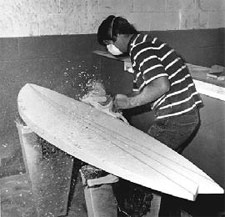
Velzy’s first shop for years helping sweep up, gluing up balsa blanks,
shaping wood fins and repairing boards.
Bing attended Mira Costa High School in Manhattan Beach until he graduated
in 1954. That summer Bing, along with Greg, Vardeman and Hap Jacobs, became
lifeguards, which allowed them to earn enough money for a trip to Hawaii.
In September of 1955, at 19, Bing flew to Hawaii. He started out in a
Waikiki rental and then moved to a Makaha Quonset hut with his friends,
Sonny Vardeman, Rick Stoner, Steve Vorhees, Mike Bright, and George Kapoo,
where they gradually learned to ride the big surf with the mentoring of
George Downing, Buzzy Trent and Peter Cole. With their funds running low,
Bing and Rick Stoner both went into the Coast Guards and were luckily
assigned to a ship in Hawaii for the next 2 years where they spent all
their leave-time surfing and pioneering much of the North Shore.
In 1958 Bing along with Rick Stoner decided to sail around the world.
They first sailed to Tahiti then continued on to Fiji and eventually New
Zealand where they introduced modern surfing and surfboards to the Kiwi’s.
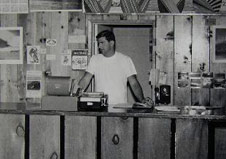
Bing opened his first surf shop in the fall of 1959 with his friend Rick
Stoner and became one of the major surfboard manufactures of the sixties
and early seventy's. A year after they opened, Rick decided to sell Bing
his portion of the business thus came Bing Surfboards. The business grew
at an exponential rate, and Bing expanded his factory to include a glassing
area and a team of first-rate shapers, including Dick Mobley, Mike Eaton, Dan Bendiksen,
John Mobley, Wayne Land, and George Lanning and then eventually Dick Brewer
also joined the team.
At one point, the factory produced up to 40 surfboards a day. In addition
to his board-building team, Bing also had a star team of riders, including
David Nuuhiwa, Dru Harrison, Chris Schlickenmeyer, and Rolf Aurness just
to name a few.
The late 60s was the beginning of the end for the major manufacturers.
It was a time of the “back yard board” and “no label”
surfboards. Bing along with his master shapers and new designers, the
Campbell Brothers, transitioned to shorter boards with a few models, but
despite Bing Surfboard’s continued popularity, sales declined and
it became obvious to Bing that the business may not survive. It was also
around this time that Bing and his wife, Conlee, decided it might be best
to move their young family away from the drug scene that had developed
surrounding Hermosa Beach. Bing decided to pursue a career change and
moved his family to Idaho.
In 1974, G&S took on the license of Bing Surfboards then Mike Eaton
continued the Bing legacy through the 80s and 90s. Until one day in Baja
in 2000, where Bing and his family spend their winters, Bing was surfing
one of his favorite spots and a car pulled up with a group of young guys.
One of the guys approached Bing and claimed to owe him some royalty money
for some Bing & Rick surfboards that he had made for Rick Surfboards.
This young man then offered to make Bing’s boards if he was ever
interested. Bing casually mentioned this to his good friend Mike Eaton,
who had been building the boards up until then, and Mike was happy to
pass along the legacy to the new generation of surfboard shapers. This
young man was Matt Calvani. To this day, Bing and his family live in the
mountains of Idaho and spend their winters surfing in the warm waters
of southern Baja, not forgetting to stop in on Matt and his surfboard
manufacturing team located at Shoreline Glassing.